
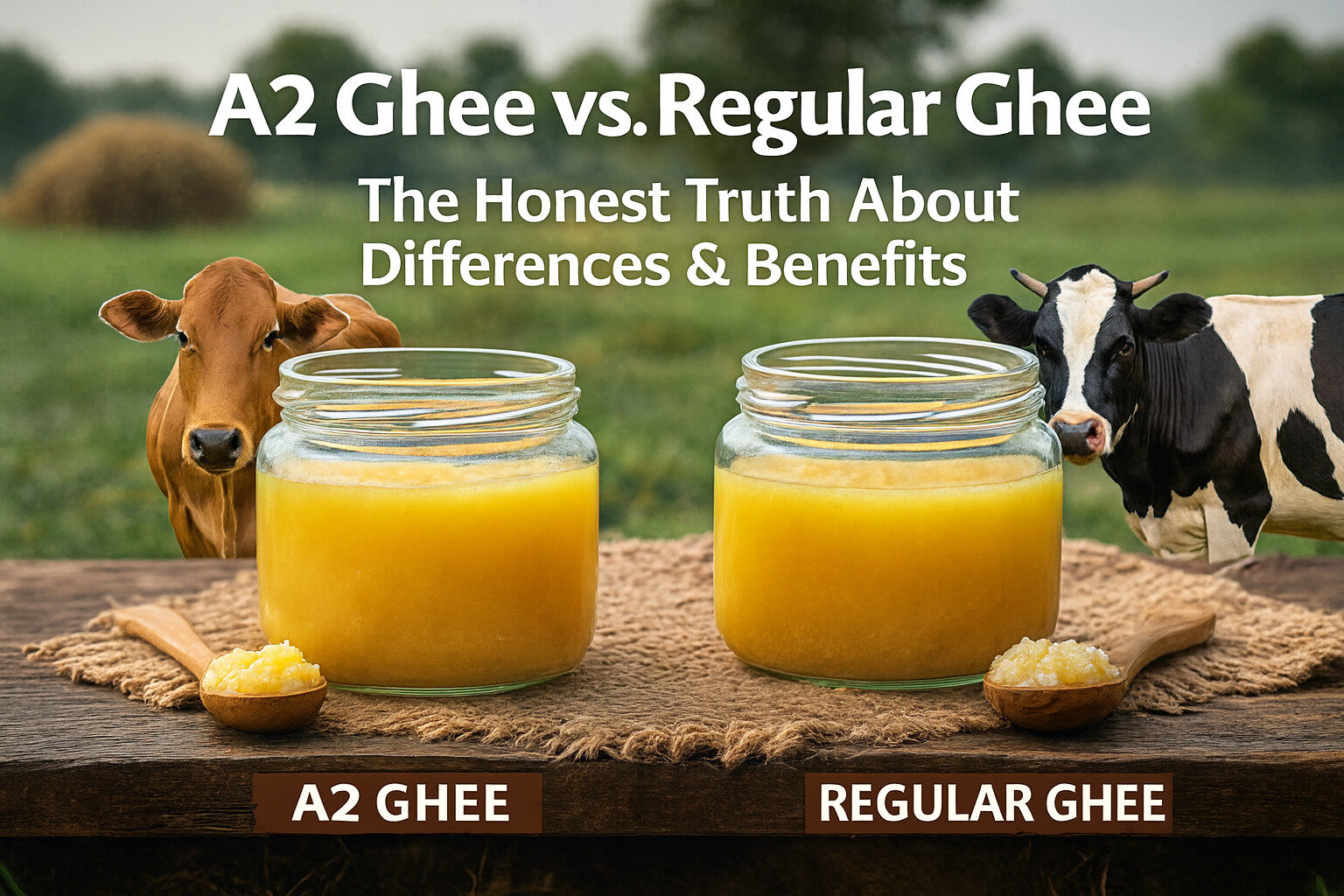
When you browse online for ghee, you’ll see countless claims: “A2 is healthier,” “A2 helps digestion,” or “Regular ghee is bad.”
But when we look closely, the truth behind A2 ghee vs. regular ghee is far simpler than the marketing hype suggests. At Desh Ka Ghee, we believe clarity is a form of purity.
Here is the science-backed explanation to help you choose wisely for your family.
Quick Summary: The Core Difference
If you are in a rush, here is the verdict: The A1/A2 difference applies to milk proteins. Ghee is almost 100% fat. 📎
1. A2 Ghee: Made from indigenous cow breeds (Gir, Sahiwal). Costs more due to lower milk yield.
2. Regular Ghee: Made from mixed breeds. More affordable.
3. Nutritional Verdict: Since the protein (casein) is removed during the ghee-making process, both are nutritionally almost identical.
What Is A2 Ghee?
A2 ghee is made from the milk of cows that naturally produce the A2 beta-casein protein. These are typically indigenous Indian breeds, such as:
- Gir
- Sahiwal
- Tharparkar
- Rathi
These breeds are traditional to India, and their milk is often praised for being easier to digest.
What Is Regular Ghee?
Regular ghee is produced from the milk of cows that may produce a mix of A1 and A2 beta-casein. This usually includes crossbred Indian cows or mixed herds.
Why buy it? Regular ghee is widely available and significantly more budget-friendly for daily cooking. 👉 Check the price of our Fresh Regular Ghee here.
The Science: Does the Protein (A1/A2) Matter in Ghee?
This is the part most premium brands avoid admitting.
The debate about A1 vs. A2 is about protein (casein). However, ghee is clarified butter. By definition, the process involves removing milk solids (proteins and sugars). 📎
The Composition of Ghee:
- ~99.5%: Pure Fat
- Lactose: Free (Removed)
- Casein (Protein): Trace to None (Removed)
The Logic: If the protein is removed to make ghee, the source of that protein (A1 vs. A2) becomes irrelevant to your health.
- ✔ No significant A1 protein remains.
- ✔ No significant A2 protein remains.
- ✔ Digestion is determined by the fat structure, which is similar in both.
Comparison: A2 Ghee vs. Regular Ghee
Here is how they actually differ in daily use.
1. Digestibility
Since the casein (protein) is removed, both A2 and regular ghee are digested the same way. People who are lactose intolerant or sensitive to casein can usually consume any high-quality, pure ghee without issues.
2. Taste & Aroma
The taste of ghee does not depend on the “A2” label. It depends on:
- The Cow’s Diet: Grass-fed cows produce better-tasting fat.
- The Method: The Bilona (churning) method produces better flavor than industrial cream separation. 📎
- Freshness: Fresh batches always taste better than stored jars.
A carefully made regular ghee can taste significantly better than a mass-produced A2 ghee.
3. Price Difference
- A2 Ghee: Expensive. Indigenous cows yield very little milk (approx 4-8 liters/day), driving up production costs.
- Regular Ghee: Affordable. Ideal for liberal use in cooking, tadkas, and baking.
4. Nutrition Chart
Nutritionally, they are nearly twins.
| Feature | A2 Ghee | Regular Ghee |
| Fat Content | ~99.5% | ~99.5% |
| Vitamins (A, D, E, K) | High | High |
| Lactose | Zero | Zero |
| Casein (Protein) | Negligible | Negligible |
| Digestion | Easy | Easy |
| Best Used For | Cultural/Medicinal use | Daily Cooking & Diet |
Desh Ka Ghee’s Honest Stand
At Desh Ka Ghee, we focus on purity, freshness, and technique—not confusing labels.
We believe you shouldn’t have to pay a premium just for a buzzword. Our regular cow ghee is:
✅ Pure & Aromatic
✅ Slow-cooked for granular texture (“Danedar”)
✅ Made in fresh batches
✅ Free from preservatives
Frequently Asked Questions (FAQs)
No scientific study definitively proves A2 ghee is more nutritious. Since the milk solids (protein) are removed to make ghee, the A1/A2 protein difference becomes irrelevant. Both are equally healthy sources of fat.
In ghee form, both digest almost the same because the protein content (casein) is negligible in both.
No. Ghee is heated at high temperatures during the clarification process. No probiotics can survive this heat, even in bilona ghee.
Yes. Pure ghee contains almost zero lactose and casein, making it generally safe for lactose-intolerant people.
A2 milk comes from indigenous cows (like Gir or Sahiwal) that produce very little milk compared to commercial dairy cows. You are paying for the scarcity of the milk, not a nutritional difference in the ghee.